If you select an inappropriate water purification system, it can cause problems in addition to unnecessary costs. The following are examples of how improper selection of a commercial water purification system can negatively impact a business.
- A dialysis clinic that uses an inadequately sized Reverse Osmosis unit may create patient-safety risks.
- A food manufacturer operating with hard municipal water without any treatment system may experience increased boiler scale buildup and higher utility costs.
- A pharmaceutical lab that doesn’t meet applicable United States Pharmacopeia (USP) Purified Water requirements may face regulatory or quality review issues.
To choose the right water filtration system, you must first ask the right questions. The purpose of this guide is to help you answer the top questions that will assist you in making an informed choice.
Question 1. What factors are involved in making the decision?
A. Know Your Source Water First
No two facilities use the same water source. Water supplied through a municipal system differs from the water drawn from a well or a surface water source. Factors such as total dissolved solids, hardness, microbial load, pH, chlorine and chloramine residues, iron content, silica levels, and many other water characteristics can vary tremendously from one source to another. To specify the proper equipment for your facility, you must first have a water analysis performed. Parameters like the feed water characteristics, the volume of water requiring treatment, the space available for installation, the equipment construction materials, and instrumentation needs all influence which water purification systems will perform effectively and which may fail prematurely.
At Flier’s Quality Water Systems, we initiate every consultation with a no-obligation system analysis for this reason. Making assumptions about feed water is the leading cause of failure in commercial water purification systems.
B. Regulatory compliance is non-negotiable
In the U.S., depending on your industry and water use, water quality requirements may involve EPA, FDA, USP, AAMI, or other applicable standards. Non-compliance is not merely an administrative issue; it can present operational and production risk.
EPA drinking water regulations establish baseline maximum contaminant levels for public drinking water systems in the U.S. Beyond these, there are additional requirements and standards that may apply to each sector.
For example, bottled water processing is regulated under FDA 21 CFR Part 129; pharmaceutical water is controlled by USP Chapter <1231> and 21 CFR 211; and hemodialysis water purity is subject to AAMI standards.
C. Flow Rate, Volume, and Scalability
Modern commercial purification systems should be designed to accommodate maximum hourly flow demands. Otherwise, future expansion may create system bottlenecks that restrict production capacity.
Make sure you have a plan to scale up, and size the system according to the greatest hourly demand you anticipate, not the average flows you operate at.
If a system is undersized, you may lose production throughput and increase costs, and if it is oversized, you may incur higher capital costs and potentially lower operating efficiency. Work with qualified engineers who can accurately model your production needs on an hourly basis rather than just quoting you based on a standard catalog page.
D. Total Cost of Ownership, not Just Purchase Price
The acquisition cost of a commercial water purification system is only a small percentage of the lifetime costs associated with it. Membrane replacements, resin regenerations, UV lamp replacements, chemicals, energy consumption, and unplanned downtime should all be considered when evaluating long-term operating expenses.
The difference between a well-designed custom system and an off-the-shelf system can often support lower operating costs over time.
For instance, RWP Inc., a CNC machining and robotic-welding company, reduced the need for anti-foam agents and extended the life of their coolants by having Flier’s install a custom reverse RO system.
Question 2. What does your industry legally require?
Pharmaceutical Water Purification Standards
Pharmaceutical water should not be regarded as just pure water. Microbial limits and monitoring expectations depend on the water type, application, and applicable pharmaceutical quality requirements.
USP Chapter <1231> provides guidance on water for pharmaceutical purposes, including common pharmaceutical water types such as Purified Water (PW) and Water for Injection (WFI), while dialysis water is addressed under separate healthcare water standards.
Both PW and WFI must meet the same standards for chemical purity, with compliance shown through conductivity testing (Stage 1 limit of 1.3 µS/cm at 25°C) and total organic carbon testing.
The minimum necessity for oral dosage forms is PW, while WFI is the minimum requirement for parenteral products. As a result, most pharmaceutical manufacturers employ a multi-stage process to purify their water: softening → carbon filtration → reverse osmosis → electrodeionization (EDI) → ultraviolet (UV) disinfection, along with a recirculating distribution loop.
Hemodialysis
Hemodialysis water originates from a source that meets EPA drinking water regulations, which is then treated to reduce chemical and biological contaminants that may pose risk during treatment.
The standard developed by AAMI and incorporated into federal regulations establishes strict biological and chemical purity requirements. However, it does not mandate specific purification technologies provided the treated water meets the required quality standards.
Food/Beverage
Under 21 CFR Part 129, the FDA classifies bottled water as a food product and requires source water testing, treatment process controls, and finished product testing before bottling.
Water quality is just as important in the production of beverages, dairy products, baked goods, and processed foods. It directly affects product consistency, shelf life, and flavor.
Yeast performance in brewing beverages is influenced by water hardness; mineral content can affect the flavor profile, and microorganisms must be controlled in food processing operations regulated under the FSMA.
Industrial, Automotive, and Laboratory Applications
Hard untreated water in the manufacturing processes, flowing through equipment such as boilers, cooling towers, and heat exchangers, can cause buildup of calcium carbonate scale. Scale buildup on heat-transfer surfaces can increase energy consumption and reduce system efficiency.
In a boiler application, mineral scale accumulation can contribute to higher fuel costs and maintenance needs.
Water with hardness levels between 120 and 150 ppm is generally considered problematic for most industrial heating operations, while high-pressure boilers are usually designed to operate at near zero hardness.
Deionized water is required in the automotive sector for a variety of applications, including mixing engine fluids, diluting antifreeze, and cleaning components. Mineral deposits within radiators and coolant systems can decrease cooling efficiency and cause costly blockages.
In the laboratory, whether medical, pharmaceutical, or material-science focused, Type I or Type II ultrapure deionized water is needed to prepare reagents, feed analytical instruments, and conduct quality control procedures where ionic contaminants can compromise the accuracy of results.
Question 3: What does your industry operationally require?
Reverse Osmosis – The primary method of commercial purification
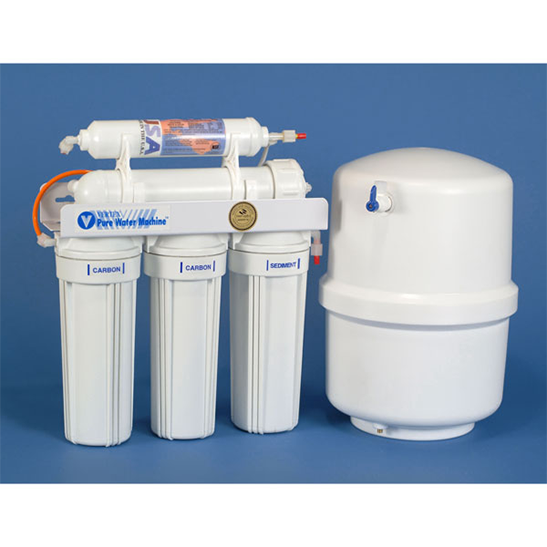
Reverse osmosis takes feedwater and forces it through a semi-permeable membrane under high pressure to separate contaminants from it by physically rejecting dissolved salts, heavy metals, bacteria, viruses, chlorine by-products, and organic compounds.
A properly designed commercial reverse osmosis system can reject a high percentage of dissolved solids and many contaminants. RO is an economical means of producing high-quality water for large-scale uses (industrial flows as low as hundreds of liters per day or as large as hundreds of thousands of liters per day).
The reverse osmosis system can also be designed to serve a variety of applications: boiler feedwater, rinse water, food-grade process water, humidifier feedwater.
Flier’s Quality Water Systems custom builds commercial reverse osmosis systems based on individual facility specifications; thus, eliminating the need for off-the-shelf units because standard configurations often result in a significant performance disadvantage when operating conditions differ from the original design assumptions.
Ultraviolet Disinfection: Microbial Destruction Without Chemicals
Ultraviolet Disinfection is performed by exposing microorganisms (bacteria, viruses, protozoa, and many others) to a specific wavelength of 254 nm. Exposure to this wavelength penetrates the cell wall of the microorganism and disrupts its DNA, rendering it unable to reproduce.
Validated commercial UV systems can provide strong inactivation of harmful microorganisms, including Giardia and Cryptosporidium. UV reactors used for regulated disinfection credit should be validated for the applicable system requirements.
The most important benefit of UV is that it does not change the chemistry of water by adding any chemical compounds or producing residual/byproducts from the UV process. Furthermore, UV does not change the odor or taste of water. Therefore, it is an extremely effective way to polish the final stage of multi-barrier treatment for water coming from pharmaceuticals, hemodialysis, food and beverage processing, and laboratory water loops.
Deionization (DI/EDI): Provides Ultrapure Water for Precision Uses
Reverse Osmosis (RO) extracts most of the dissolved solids from water; however, there might still be some residual ionic species left. Deionization helps remove remaining ionic contaminants from the treated water.
A deionization system utilizes synthetic organic ion exchange resins. The cation resin reduces positively charged ions while the anion resin filters out negatively charged ions.
The deionization system will typically produce deionized water with a resistivity of 10 MΩ·cm (megohm-centimeter), with ultrapure systems achieving 18.2 MΩ·cm for critical pharmaceutical use cases.
Water Softening
Water softening is the process of exchanging cations (positive ions) that make water hard – specifically calcium and magnesium – with sodium cations, a softening agent. This process forms the basis for protecting equipment, conserving energy, increasing the life of assets, and lowering the cost and frequency of maintenance in plants.
Water softening is also commonly the first step of a multi-stage treatment process before Reverse Osmosis or De-Ionization. If water is not softened before RO or DI treatment, hardness ions can accumulate on RO membranes, reducing membrane life and increasing operating costs.
Collaborate with Engineering Experts, Not Just Salesmen
Located in Byron Center, Michigan, Flier’s Quality Water Systems produces customized commercial water purification systems for organizations in the pharmaceuticals, manufacturing, healthcare, automotive, laboratory, food & beverage, hemodialysis, and agricultural sectors.
We have engineered systems for clients throughout North America. All systems are tailored to meet your specific feed water characteristics, the regulatory environment you operate under, flow rate or velocity requirements, and any other limitations imposed by your facility design.
We are one of the few companies in the water purification industry to offer FDA-regulated GMP resin regeneration services, providing clients with an alternative to replacing their resins.
Are you ready to identify the correct system for your needs?
Request a no-obligation system analysis for your existing water purification system, or contact Flier’s to discuss the right solution for your facility. Call: (616) 583-9040; Email: purewater@fliersinc.com