
Any time a bioburden exceeds the allowable limit, there is the potential for batch rejection, an FDA Form 483 observation, or product recall due to microbial contamination.
Water purity is more than just a background operational concern for pharmaceutical manufacturers. It can directly affect regulatory standing and patient safety, making it critical to manage water quality as a key variable within the critical path for success.
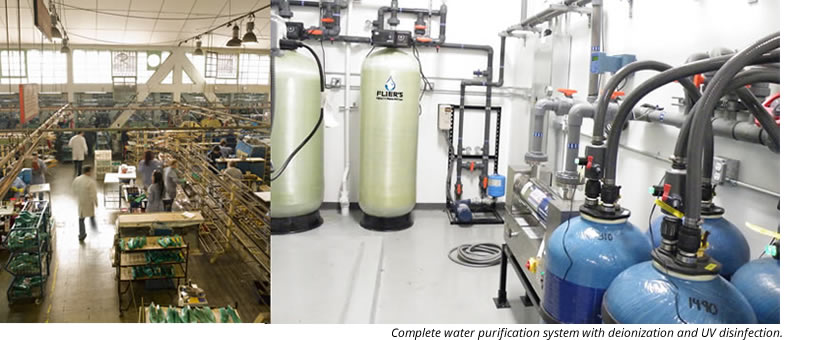
Flier’s Quality Water Systems has built, deployed, and sustained UV systems that are custom-built for use in pharmaceutical water loops to support microbial control and applicable pharmaceutical water quality and cGMP requirements.
Filtration removes particles, while reverse osmosis reduces dissolved solids and can also reduce microbial contaminants. However, these processes should not be relied upon alone as the sole microbial control strategy for a pharmaceutical water system.
Biofilm in a recirculating purified water loop can begin to develop and grow faster than it can be detected through normal testing processes.
UV systems for the pharmaceutical industry address this gap with every pass through the system without leaving behind chemical residuals that could affect downstream operations or the integrity of the finished product.
If microbial control is becoming a concern in an existing purified-water loop, Flier’s application engineers can help review the system configuration and operating conditions.
Flier’s UV systems are designed to support microbial control in pharmaceutical water systems while addressing the operational and documentation requirements associated with regulated environments.
Properly designed UV treatment can provide continuous microbial control as water passes through the system. System sizing and operating conditions are important to ensure the required UV dose is delivered at the actual flow rate.
UV treatment provides microbial control without introducing chemical disinfectants or leaving chemical residuals in the treated water. This can help support downstream processes where chemical residuals may be undesirable.
Proper UV sizing is essential for maintaining the intended microbial-control performance of a pharmaceutical water system.
If a unit is too small, it will not produce enough UV dose at the actual system flow rate. As a result, microbial control can fall below acceptable performance levels without any visible indication of failure.
Flier’s UV systems are configured for applicable peak operating conditions to support the performance demonstrated during validation and routine operation, subject to ongoing monitoring, maintenance, and requalification.
Flier’s provides documentation packages designed to support the qualification and verification of UV systems used in pharmaceutical water applications.
Flier’s provides IQ/OQ documentation packages containing information related to factory acceptance testing (FAT), installation qualification, and operational qualification.
These packages are developed with reference to applicable FDA 21 CFR Part 211 requirements and GAMP 5 guidelines. The documentation provides internal quality teams and external auditors with a record of system verification and performance from initial start-up onward.
Factory acceptance testing helps document system performance before installation. Combined with installation and operational qualification documentation, this provides a structured record for system verification.
Flier’s systems operate at 254 nm, a wavelength commonly used for germicidal UV treatment. UV energy at this wavelength can cause damage to microbial DNA, preventing affected microorganisms from reproducing.
This provides a non-chemical approach to microbial control for pharmaceutical water systems, including organisms such as Pseudomonas aeruginosa and Burkholderia cepacia.
Proper UV system performance depends on more than initial installation. Sizing, operating conditions, monitoring, maintenance, and periodic requalification all contribute to continued system performance.
Flier’s application engineers can help review your existing water loop, operating conditions, and UV requirements to determine an appropriate system configuration.
USP <1231> advises users to establish microbial specifications appropriate to their water use. These values generally should not exceed 100 CFU/mL for Purified Water or 10 CFU/100 mL for Water for Injection unless otherwise justified.
Water for Injection also has a bacterial endotoxins limit of 0.25 EU/mL under USP compendial requirements.
The systems producing this water must be able to maintain these specifications while operating at maximum design flow, not just during qualification testing, while also meeting internal quality requirements and applicable regulatory expectations.
If a UV unit is too small, it may not deliver sufficient UV dose at the actual system flow rate. This can reduce microbial-control performance without providing an obvious indication of failure.
Flier’s UV systems are configured for applicable peak operating conditions to support validated performance during routine operation, subject to ongoing monitoring, maintenance, and requalification.
Flier’s provides IQ/OQ documentation packages containing information related to factory acceptance testing (FAT), installation qualification, and operational qualification.
The documentation is developed with reference to applicable FDA 21 CFR Part 211 requirements and GAMP 5 guidelines and provides quality teams and auditors with documentation of system verification and performance.
Flier’s ultraviolet systems operate at 254 nm to provide germicidal UV treatment. UV energy can cause irreversible damage to microbial DNA, preventing affected microorganisms from reproducing.
The systems are designed to support microbial control in pharmaceutical water applications, including microorganisms such as Pseudomonas aeruginosa and Burkholderia cepacia.
Need to compare UV sizing, validation support, or service options for your facility?
Reach Flier’s at (616) 583-9040 or purewater@fliersinc.com and share what your water loop needs to handle.

