
Water Filtration for Manufacturing Industry
From light to heavy manufacturing, we design, deploy, and maintain reliable water purification systems. Flier’s solutions can be configured to support a wide range of plant requirements, from high-purity and pharmaceutical-grade water systems to basic filtration, softening, closed-loop reuse, recycling, and zero liquid discharge systems.
We offer complete water filtration for the manufacturing industry, combining expert engineering, advanced systems, and 24/7 support to help improve operational efficiency.
Standard and custom-engineered systems built to provide the highest performance.
Reduced water consumption can help lower inlet, treatment, and discharge costs.
Systems designed to help facilities address applicable FDA, OSHA, and other state, federal, and regional environmental and workplace safety requirements.
Flexible approaches to satisfy industry-specific requirements.
Higher, more consistent water quality means predictable process results and fewer production variabilities.
Less planned and unplanned downtime.
High-quality filtration extends equipment life.
Longer component life lowers replacement frequency.
Faster ROI with sustained operational savings over time.
Water filtration in manufacturing involves a wide range of methods for treating, filtering, and recycling water throughout industrial processes. In this context, water is treated from incoming source preparation through process management and final discharge in accordance with regulatory requirements.
The specific treatment system configuration depends on the application and operational requirements.
Flier builds industrial water treatment systems for the most common manufacturing workflows.
The efficiency of any cooling system depends on three major factors: scale, corrosion, and biological fouling.
By using a combination of softening, filtration, and chemical-free treatment systems, our experts engineer solutions that boost equipment effectiveness while lowering energy usage for open-loop systems.
Water must be of sufficient purity to prevent scale buildup and carryover that can damage boilers and steam distribution networks.
Flier delivers deionization and reverse osmosis systems sized and configured specifically to address the conductivity and silica needs of each boiler.
The level of purity of the rinse water at every stage of metal fabrication and finishing directly affects coating adhesion, visual finish quality, and reject rates.
We supply deionized and softened water systems that can also be integrated with closed-loop reuse systems to decrease water usage and limit discharge volumes.
Backed by two decades of hands-on experience, Flier has supported manufacturers in North America with both system installations and round-the-clock assistance.
Water treatment systems utilized in manufacturing processes vary based on each manufacturer’s requirements.
Softeners eliminate mineral hardness that leads to scaling in heat exchangers, cooling towers, and boilers.
A reverse osmosis (RO) system helps create high-purity process water by separating dissolved solids, organic material, and ions from the water.
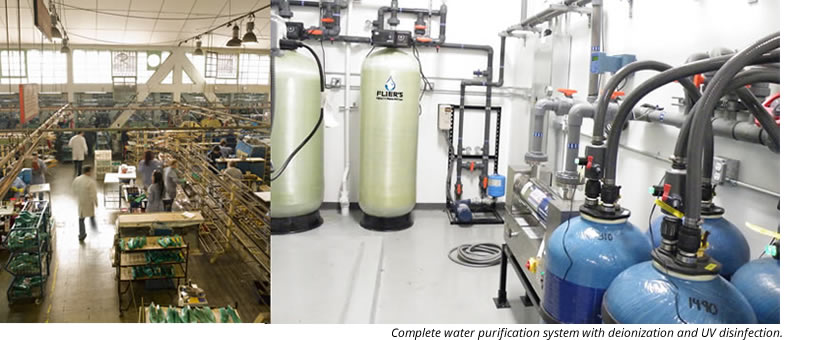
Using deionization (DI), ultrapure water can be produced for surface finishing, electronics manufacturing, and contamination-sensitive operations.
How manufacturing water will be regulated depends upon the particular application and industry.
Process water employed by FDA-compliant manufacturers must be classified in accordance with applicable FDA regulations under 21 CFR standards.
Industrial discharges must meet EPA Clean Water Act and State NPDES permit requirements.
In many states, cooling towers are required to comply with ASHRAE 188 Legionella risk management standards.
Zero Liquid Discharge (ZLD) is a treatment process that can be applied to recover and reuse a high percentage of wastewater or reject water generated by a manufacturing facility.
ZLD treatment systems can help remove reliance on sewer or surface water discharge.
Manufacturing facilities typically implement ZLD systems when discharge regulations are strict or when water reuse is financially viable.

