
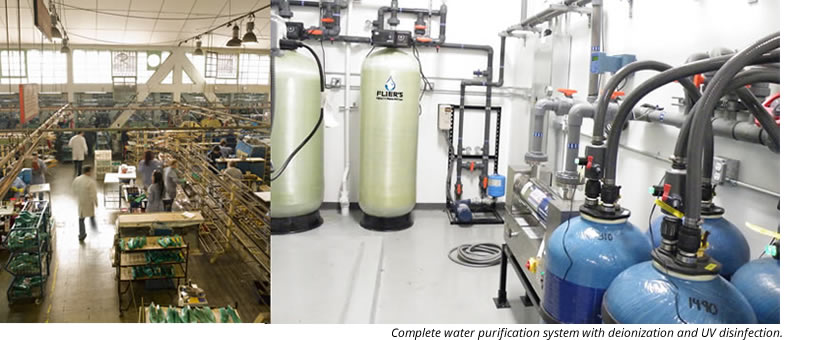
There are several ways in which hard water can negatively affect food processing operations, including in boiler and steam systems, Clean in Place (CIP) systems, ingredient process water quality, and reverse osmosis membrane performance. Each of these applications has specific hardness tolerance levels and unique operational challenges if those limits are exceeded. Therefore, Flier’s creates tailored water conditioning systems for each food processing facility to address the distinct water chemistry, production requirements, and regulatory needs of that facility.
Even 1 – 2 mm of scale buildup on a heat exchanger can increase energy consumption by approximately 3% to 6 % in that system. Softened boiler feed water can help reduce mineral buildup, support thermal efficiency, and minimize production interruptions caused by descaling maintenance activities.
When dissolved calcium in hard water reacts with alkaline cleaning chemicals, the result is insoluble soap deposits that reduce the effectiveness of the cleaning agents. With suitably treated CIP water, cleaning formulations perform at their rated concentration across every cycle.
The mineral composition of source water can strongly influence food product quality, consistency, and process performance. Simply adjusting formulations to compensate for mineral content may not always attain the expected food quality or safety standards. For example, calcium levels in bakery products affect the development of gluten; the level of bicarbonate impacts pH and yeast activity in fermentation, and magnesium levels alter the functioning of enzymes during the brewing process. Where batch-to-batch consistency is critical, sustaining controlled mineral levels at ingredient water take-off points becomes essential.
In the production of high-purity water via an RO process, uncontrolled levels of hardness in the feed water can trigger faster scaling of membranes, reduce membrane flux, and shorten membrane replacement cycles. Deploying hardness removal as a pretreatment step can help protect RO system performance and reduce the cost of producing high-purity process water.
Need help evaluating water softening for food processing? Contact Flier’s to discuss your facility’s water quality, CIP, boiler, and RO pretreatment needs.
Most alkaline cleaning formulations become less effective when the water hardness exceeds about 150 mg/L as CaCO₃. The chelating agents within the cleaning solutions are consumed in neutralizing dissolved minerals instead of assisting with soil and residue removal from processing surfaces. Chemical consumption reports for these facilities in high hardness areas (>250 mg/L as CaCO₃) frequently reveal this problem before product quality control evaluations do.
Under FSMA’s Preventive Controls for Human Food rule, water quality may need to be evaluated as part of the facility’s food safety plan when it is relevant to the process. For water softening systems, facilities should maintain documentation showing that the system is being properly managed and monitored. This documentation typically includes system validation records, preventive maintenance schedules, monitoring procedures, and corrective action records.
Municipal water hardness levels vary throughout North America, ranging from below 60 mg/L in cities such as Vancouver and Seattle to over 300 mg/L in cities like Phoenix and Calgary. Manufacturers that operate multiple sites and use standardized formulations without site-specific calibration of their water treatment create an uncontrolled variable that often appears first in product quality control data.

