
Food processing firms commonly face many types of water-related challenges. The use of ingredient makeup water can introduce pathogens into the food. Produce wash lines can recirculate contamination from the same produce multiple times unless process water is properly treated.
CIP rinse water circuits can also re-contaminate equipment surfaces because the final rinse often uses source water that may still contain viable microorganisms.
Each represents a distinct potential failure point.
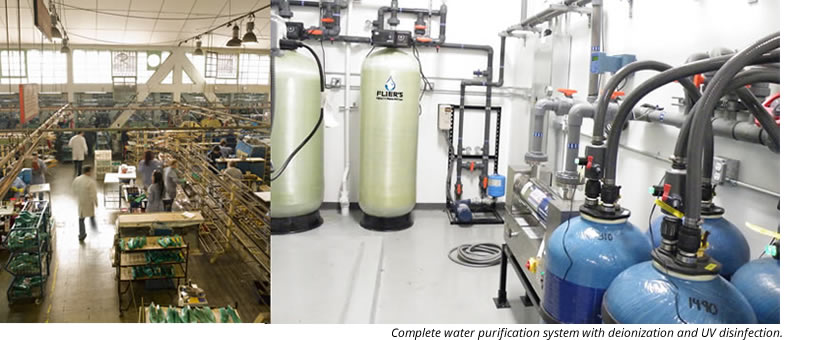
The engineers at Flier’s Water Quality Systems design UV disinfection systems that are validated for each individual point of application to NSF/ANSI 55 Class A standards.
These systems include inline dose-monitoring capabilities that generate verification records in line with the documentation requirements referenced during FSMA inspections.
For broader food-safety context, the U.S. Food and Drug Administration (FDA) places hazard analysis, preventive controls, and documented monitoring at the center of FSMA requirements for covered food facilities.
If your plant is reviewing ingredient, wash, or CIP water treatment, Flier’s application engineers can help you work through where UV fits in the process based on your actual water quality and flow conditions.
Almost all bacterial pathogens found in processing water can be controlled through chlorine disinfection. However, Cryptosporidium parvum and Giardia lamblia are exceptions because they are protozoa, not bacteria.
Both organisms can survive chlorine concentrations considered safe for product-contact applications.
This characteristic has been one of the reasons these protozoa are a concern under the FDA’s Produce Safety Guidance document.
At the dose of 40 mJ/cm² of UV radiation, both Cryptosporidium parvum and Giardia lamblia can have their DNA replication disrupted, achieving up to a 4-log reduction without the use of chemicals.
This dose is validated under end-of-lamp- life conditions -the same benchmark regulators use to evaluate system performance.
Unlike generic chlorine-based filtration solutions, a properly-instrumented UV unit consolidates this compliance data automatically, removing the need for manual logging.
Chlorine delivered through the municipal supply gradually loses its strength as it travels through plumbing systems to areas such as the produce wash line or the final CIP rinse points.
Secondly, there are no validated log reduction requirements for protozoa at the municipal level of treatment.
UV systems for food processing directly deployed at the point of use address these two limitations before the water contacts raw food products.
No. UV treatment is photolytic; this means the disinfection mechanism is radiation- based, not chemical- based, therefore it does not form any byproducts, change the pH levels, or chemically alter the dissolved minerals or conductivity of the water before and after the treatment.
Sizing calculations are made based on the worst-case operating conditions.
This means that Flier’s considers peak flow rates, the lowest recorded seasonal UV transmittance and the end of lamp life dose output.
If you want to sanity-check UV sizing against your actual peak flow and UV transmittance, reach Flier’s at (616) 583-9040 or purewater@fliersinc.com and share your operating range.

