
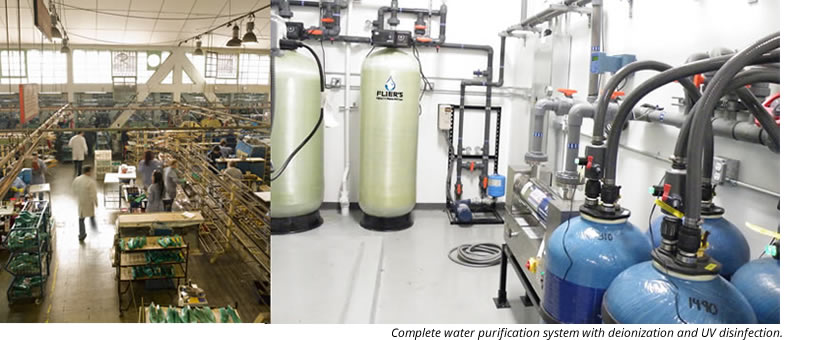
The FDA’s Food Safety Modernisation Act (FSMA) Produce Safety Rule stipulates farms using surface water, such as open source pond water, for crop irrigation to meet certain microbial quality standards. With conventional chlorination alone, accomplishing these might be challenging. The amount of chlorine required to reduce E. coli to acceptable levels may cause severe phytotoxic effects, like leaf scorch and root tip damage in sensitive crops. However, there is no phytotoxic limit to the dose of UV, provided it is sufficient enough to eliminate E. coli contamination.
For regulatory context, the U.S. Food and Drug Administration (FDA) administers the FSMA Produce Safety Rule, including agricultural-water requirements for covered produce farms.
A complication with surface water irrigation is that these sources typically have UVA light transmittance (UVT) values lower than the threshold needed for successful treatment. Without adequate UVT, a UV system may not deliver its validated UV dose during peak seasonal pathogen pressure.
Flier’s specialised engineering team develops and fabricates UV systems for agriculture. Instead of using pre-packaged UV sizing designs, we rely on the actual transmittance data from the water source and the maximum system flow rate of the irrigation system.
If you’re evaluating UV for surface water, greenhouse, or hydroponic use, Flier’s application engineers can help you work through UVT, peak flow, and where UV fits into the broader irrigation-water treatment train.
Want to see how other organizations describe working with Flier’s? Read Flier’s customer testimonials.
For surface irrigation water, the Produce Safety Rule establishes a geometric mean of 126 CFU (Colony Forming Units) per 100 mL and a statistical threshold value (STV) of 410 CFU per 100 mL for generic E. coli. Any operation that exceeds the STV must take corrective action before using the water again. Thus, appropriately sized UV systems for agricultural applications (designed according to E. coli inactivation dosing) can help demonstrate compliance with these standards.
UV radiation inactivates microorganisms through a photolytic process that targets microbial DNA. It does not react with dissolved ions or compounds responsible for electrical conductivity, though some chelated micronutrients (particularly iron) may degrade. The primary waterborne pathogen in recirculating hydroponic systems, Pythium spp., can be neutralised using UV radiation. Therefore, recirculating nutrient solutions remain microbiologically treated, maintaining nutritional stability after passing through the UV chamber, though periodic monitoring of iron levels may be necessary.
When sizing agricultural UV systems, two critical factors define capacity: maximum flow rate and the minimum UV transmittance (UVT). UV dose delivery depends on the time of exposure (i.e., the shorter the time of exposure, the lower the UV dose). Surface water sources typically have their lowest UV transmittance during extreme rainfall events, which often coincide with the highest irrigation demand. To accurately account for both extreme flow rates and low UV transmittance, Flier’s experts use worst-case conditions simultaneously in their analyses, rather than using only seasonal averages, to ensure the system delivers a validated dose under the most challenging conditions in accordance with NSF/ANSI 55 Class B standards.”
Want to sanity-check UV sizing against your source-water conditions? Reach Flier’s at (616) 583-9040 or purewater@fliersinc.com with your flow range, UVT data, and application details.

