
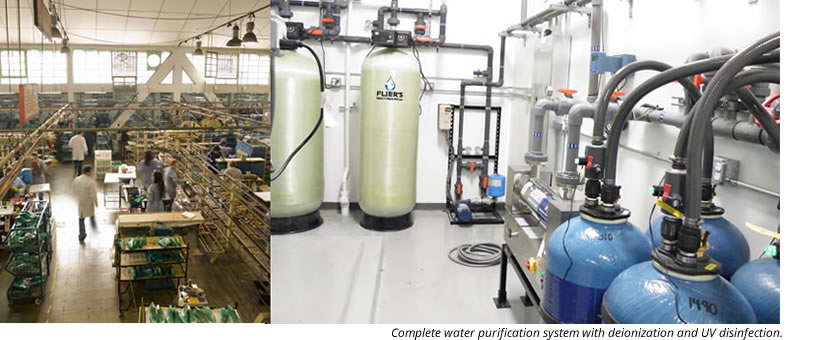
The quality of process water directly affects the repeatability of product batches. Fluctuations in microbial populations across manufacturing lots can lead to differences in finished product integrity, creating inconsistencies that may be noticed by consumers, flagged by quality assurance teams, and potentially result in chargebacks or delisting by customers within the supply chain.
Flier’s UV disinfection technology is developed to neutralize a major source of variability by targeting the biological contamination in the manufacturing process, rendering a stable and predictable feed water supply for high-throughput operations.
Chlorine-based disinfection leaves residuals in the finished water. These can form disinfection by-products (DBPs) and may cause taste and odour issues when the process water comes into contact with products in food processing, cosmetics filling, and electronics rinsing applications. UV treatment at 254 nm inactivates microorganisms by disrupting their DNA. It adds nothing to the water and leaves the water chemically and physically unchanged.
Certain waterborne microorganisms, such as Cryptosporidium parvum and Giardia lamblia, can survive the chlorine concentrations used to purify industrial water. Flier’s UV systems for manufacturing disable these two organisms, making it a preferred option for facilities using municipal or surface water sources where these species are a concern. UV filtration is also instantaneous, as it does not require holding tanks, contact time, or chemical quenching before the conditioned water enters the production.
Plant schedules are perpetually fluid. Partial line utilisation, seasonal spikes in demand, and flow rates rarely matching the maximum design rate all affect the throughput requirements. Flier’s UV systems are built to preserve a validated dose over the entire range of operation from minimum to maximum flow. This enables every capability level to receive the same level of microbiological protection without over-treating your system at low flows or under-treating during high-flow periods.
If UV is being considered for a new line or an existing treatment train, Flier’s application engineers can help you work through flow rates, feed-water conditions, and where UV fits in the process.
UV systems for manufacturing provide specific targeted control of microorganisms, but it does not mitigate dissolved solids, heavy metals, or other chemical constituents. UV delivers the best results as a final disinfection step, downstream of filtration and water conditioning processes. In this configuration, it diminishes biological risk without affecting the chemical quality of the water already achieved by the upstream filtration stages.
The delivered dose of UV is confirmed during commissioning through validation procedures that combine measured lamp intensity and operating flow rate. For many manufacturing applications, at least 40 mJ/cm² of UV must be applied to achieve a 4-log reduction in pathogens. Flier’s experts document these results during initial start-up and re-verify system functionality during each scheduled service visit.
For an external technical benchmark, the U.S. EPA’s UV Treatment Toolkit outlines UV design, validation, monitoring, and operating considerations for regulated drinking-water systems.
Routine maintenance typically requires replacing lamps every 9,000 to 12,000 hours of use and cleaning quartz sleeves to sustain UV transmittance. Flier’s system care programs keep track of lamp operating hours and confirm acceptable UV output, to prevent unexpected outages and regulatory concerns.
Need to compare UV sizing, lamp service, or integration with existing filtration? Reach Flier’s at (616) 583-9040 or purewater@fliersinc.com and share what the line needs to handle.

