
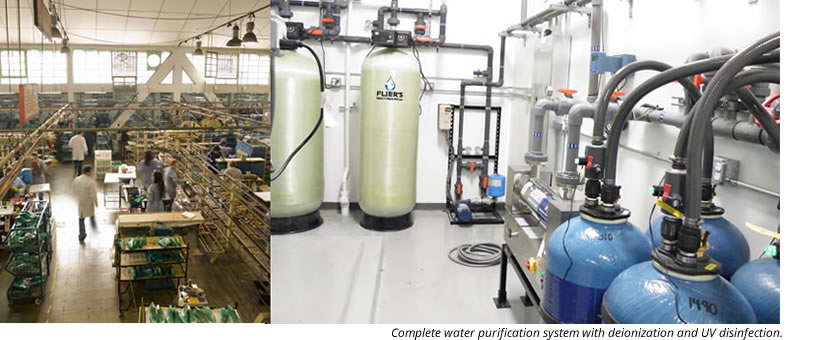
Laboratory water serves as a reagent rather than a utility, since preparing buffers,
performing cell cultures, or conducting chromatographic analyses requires
contamination-free water with no viable organisms or biological residue present
that standard filtration alone cannot reliably remove at the point of use.
For a recognized laboratory-water benchmark, ASTM International’s ASTM D1193-
24 defines reagent-water characteristics including conductivity, total organic carbon
(TOC), endotoxins, and microbiological contamination.
UV treatment inactivates these at the molecular level. Flier’s Quality Water Systems
creates lab-configured UV solutions, built for process-critical environments.
RO or DI systems do not prevent microbial growth in the distribution lines between
the treatment stage and immediately before use, which is a well-documented
source of contamination in lab water systems.
UV-C treatment at 254nm helps
tackle this issue by disrupting microbial DNA and RNA through photodimerization,
preventing cellular replication effectively.
Unlike chemical disinfectants, UV systems for labs do not introduce anything into
the water.
Mass spectrometers, HPLC & ICP workflows frequently need TOC levels below the
10ppb threshold, which standard UV disinfection- only systems are insufficient to
reach.
At a wavelength of 185nm, UV energy can photooxidise dissolved organic
compounds by breaking carbon bonds, converting these into CO2 and water.
To determine whether a UV system can fulfill the desired water quality
requirements, it is important to accurately evaluate the actual 185nm UV dose
delivered under real laboratory operating flow rates, not the theoretical values.
If you’re fitting UV into an existing RO/DI loop, Flier’s application engineers can
help you work through flow rates, water-quality targets, and where UV belongs in
the treatment train.
No, this distinction is important to both pharmaceutical and microbiological
laboratories. At 254 nm, UV disables bacteria and viruses that produce endotoxins,
but does not physically remove existing endotoxins from the water. To get water
free of pyrogens, you will need either ultrafiltration or distillation in addition to UV
sterilization.
The germicidal output from a UV lamp gradually decreases over time, although it
may continue to emit visible light. A lamp that appears to be operating may still be
delivering a deficient UV dose. For validated laboratory applications, UV lamps are
generally replaced after 9000 hours of operation. System performance should be
confirmed by continuously monitoring the intensity of the UV output with a
calibrated output sensor.
Mass spectrometry and proteomics are highly sensitive techniques that can quickly
reveal the effects of organic contamination in water, indicating potential gaps in UV
treatment or other purification stages.
The initial step in successful UV integration is conducting a detailed flow rate audit
to determine the combination of lamp intensity and contact time necessary to
accomplish the target UV dose.
This requires measuring the actual peak demand in the facility. Factors such as the
configuration of the chamber within the treatment
train, compatibility of pipe materials, and proximity of the UV system to the point of
use all affect the dose received.
Have a lab water loop that needs a closer look? Reach Flier’s at (616) 583-9040 or
purewater@fliersinc.com with your flow rate, point-of-use, or TOC concerns.
• What Is Deionized Water Used For?
• Deionized Water vs Other Purified Water: Key Differences
• Properly Designing Reverse Osmosis Systems

